Tully Hart
Firefly LaneTully Hart’s life is shaped by two opposing forces: the childhood conviction that people leave, and the friendship with Kate Mularkey that promises they will not. She grows into a celebrated television personality, yet professional success cannot extinguish her longing for her mother’s approval or replace the bond that began on Firefly Lane. When Kate is dying, Tully makes that bond her priority, stepping away from her show and affirming that the friendship survives even death.
Identity and Early Life
In 1970, ten-year-old Tully lives in a quiet house on Magnolia Drive with her grandparents. While the country is undergoing upheaval, her domestic world is orderly and subdued: she builds a Lincoln Log cabin for her dolls on the cold wooden floor, and there is no radio in the living room. Her grandmother prefers needlepoint, making Bible-quoting samplers for church fundraisers; her grandfather, weakened by a stroke, stays in bed and rings a bell when he needs help. The stillness of this home frames Tully’s early isolation and her hunger for a different life.
That isolation is bound up with her mother’s absence. After Tully is found alone, a man takes her back to the house on Queen Anne Hill, where her grandmother holds her and says the separation is not her fault. Tully cannot accept the reassurance. She decides that she must somehow have done something wrong and imagines that, if her mother returns, she will try harder, become president, and never say she is sorry again. The scene makes ambition and self-blame part of the same childhood response: Tully wants to become impossible to overlook, while interpreting abandonment as a verdict on herself.
Friendship and the Promise of Belonging
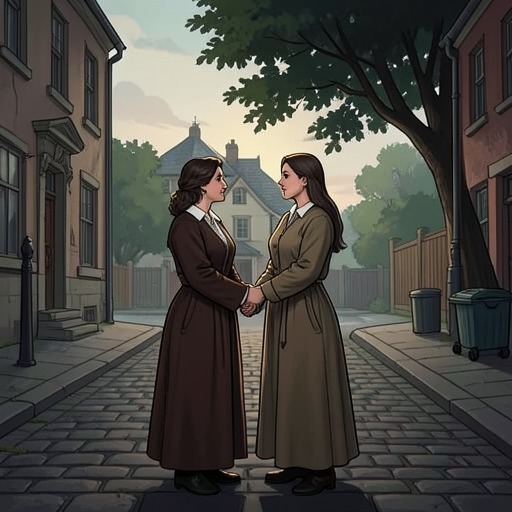
Tully and Kate become the defining relationship of each other’s lives. As girls, they meet at night on the road between their neighboring houses and share stolen cigarettes, tears over the lyrics of “Billy, Don’t Be a Hero,” and their private confidences beside the Pilchuck River. By the end of that summer, their lives are so intertwined that others know them simply as TullyandKate. The name captures more than closeness: their friendship becomes a durable support through changing decades, even as the music around them changes.
The promise of permanence is spoken directly between them. When Kate asks whether they are friends, Tully’s visible vulnerability breaks through her boldness; she immediately follows the affirmation of friendship with offers of help, fashion advice, and a plan to visit after school. Later, Kate solemnly promises that they will be best friends forever and that she will always be there, no matter what. The pact answers Tully’s fear of being left, but the novel gives it weight not as a guarantee against every rupture, but as a commitment the two women continue to test and renew.
That chosen family becomes concrete when Tully is without a stable home. Kate believes another family might be found for her, but Mrs. Mularkey tells Tully that Kate wants her to live with them. The offer strikes Tully like a blow to the heart, and she answers with disbelief rather than allowing herself to trust it. Mrs. Mularkey makes clear that living in their house will mean chores, rules, and no funny business. The welcome is therefore not an abstract rescue: it is an invitation into an ordinary household with expectations, precisely the kind of lasting place Tully has difficulty believing she can have.
Ambition, Motherhood, and the Search for Cloud
Tully’s professional success does not resolve her need for her mother’s admiration. When she considers making a mother-daughter reunion into television, she sees both the emotional danger and the career opportunity: the reunion could humiliate her, but it could also become a compelling portrait and raise her public recognition. She asks Johnny Ryan to come with her and be her producer. The decision entwines the private wound with the public ambition that has grown around it; Tully is not merely seeking a reunion, but choosing to make that search part of her work.
The encounter exposes how little success can protect her from the old longing. Cloud, living in visibly deteriorated circumstances, looks at Tully with suspicion and asks whether she is in New York getting rich and famous. Tully answers that she is both, and hears pride in her own voice, even as she recognizes that she still craves this woman’s approval after years of disappointment. She sees Cloud’s palsied hand, gray-threaded unkempt hair, stained clothes, and face marked by cigarettes, alcohol, and a life poorly lived. The contrast between Tully’s fame and Cloud’s decline does not make the daughter indifferent; it makes the persistence of her attachment more painful.
The relationship remains unstable rather than reaching a simple reconciliation. A nurse at Harborview Hospital calls Tully about her mother, Dorothy Hart, reporting a suspected drug overdose and serious injuries from a beating, with police waiting to question her. The name on the call connects Tully’s famous adult identity to the daughter who once waited for her mother to return. Even in the midst of her own later crisis, Tully carries forward the unfinished question of Cloud: Kate asks her to look Cloud up again, tying Tully’s future care for her mother to Kate’s confidence in her.
Public Failure and Private Estrangement
Tully’s instinct to help can become a breach of trust when it overrides another person’s dignity. On national television, a segment about a controlling mother and her child makes Kate realize that she is being presented as a bad mother in front of her own family. She pulls her arm away from Tully. Tully says she is scared for Kate and Marah, and that Johnny begged her to help, but the intervention has already turned a private family conflict into a public spectacle. Tully’s concern is real, yet the broadcast’s exposure of Kate creates a wound that good intentions cannot undo.
The fracture is heard in the unanswered message that Tully plays repeatedly. Kate’s voice accuses her and then the call ends; Tully flinches at the disappointment and hears the accusation as incompatible with the friend who once promised to remain forever. Memory sharpens the hurt: she measures the present Kate against the girl who would never, she thinks, have taunted her and hung up. When the two finally speak, their exchange is blunt. Tully calls Kate the one who is being a bitch and says she is angry; Kate calls her a narcissist and refuses to apologize. The quarrel does not erase their attachment, but it shows that the old vow cannot substitute for confronting the harm between them.
Change, Farewell, and Lasting Significance
As Kate’s illness advances, Tully’s priorities become unmistakable. Before entering Kate’s room, she makes what feels like the longest walk of her life, with Johnny leading her to the doorway. She feels alone amid people talking quietly, then gathers herself, tries to form a smile, and approaches her sleeping friend. The scene reverses the childhood pattern of waiting for someone who has left: this time Tully crosses the distance herself, toward Kate, even when she cannot know how much of her presence Kate can recognize.
Tully makes that choice public as well as private. During a broadcast that educates viewers about inflammatory breast cancer, she interviews guests, shows pictures, and urges the audience to obtain yearly mammograms and watch for changes beyond lumps. At the close, she tells Kate that she is the best friend she has and the best mother she knows, also making an affectionate exception for Mrs. Mularkey. Instead of her usual sign-off, Tully announces that the show will be her last for a long while because she is taking time off to be with Kate. She calls television a show and real life the life made with friends and family, then removes her microphone and leaves the stage. The gesture gives public form to a reversal: the career that once offered Tully a way to become seen now yields to the relationship that has seen her across her life.
Kate asks Tully to watch out for Marah and the boys and to look up Cloud again. Tully promises she will, and Kate takes comfort in knowing that Tully keeps her word. That trust makes their friendship larger than a memory of childhood: it becomes a responsibility carried forward to the people Kate loves and to the mother Tully still hopes to find. Tully’s promise is both an inheritance and an unfinished task.
After Kate’s death, “Dancing Queen” carries Tully back to their youth. She stands in the street, unsure whether she is laughing or crying, but certain that she is not alone in the deepest sense: Kate is gone, yet more than three decades of shared good times, bad times, music, and memories cannot be taken away. The best-friends-forever promise does not cancel bereavement; it gives Tully a language for living through it. She begins to dance alone in the street, turning a song they shared into an act of farewell and continuity. Her arc rests on that distinction: the people she loves may leave, but the friendship she and Kate made remains part of how she moves through the world.